
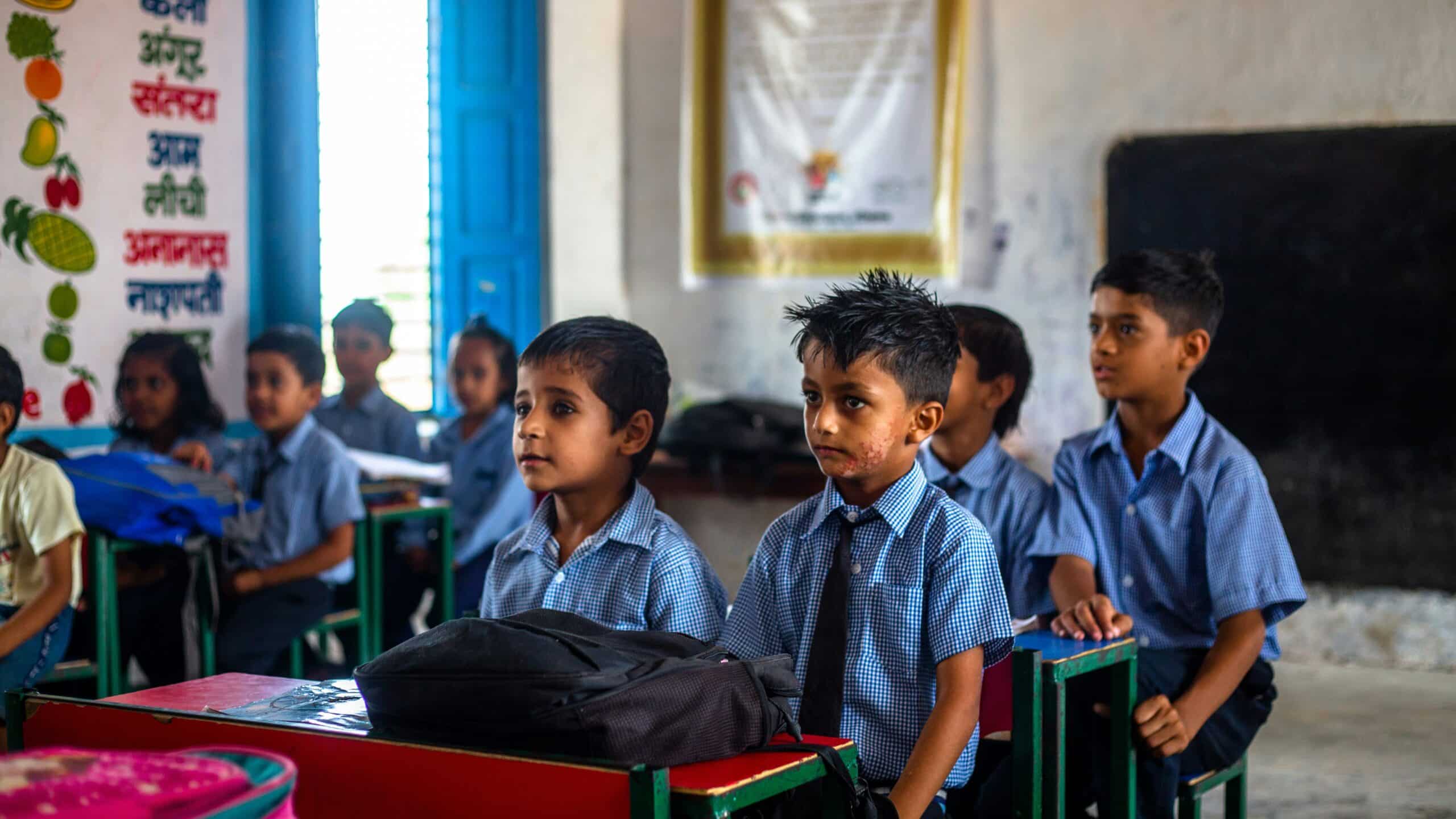
In August of last year, a 13-year-old boy in Ahmedabad, India hid a knife in his backpack. He went to school as always, and on this day, used the knife to fatally stab another student.[i] Unfortunately, this is not an isolated incident of violent inter-personal conflict in schools. News publications across India have reported a surge in school violence, including stabbings after minor arguments, teachers assaulted, and fights filmed for social media.[ii] The typical response calls for more surveillance. After the Ahmedabad stabbing, the school installed 60 new CCTV cameras and hired 35 additional security personnel before restarting classes.[iii] But surveillance addresses symptoms. It does nothing about why boys are reaching for knives in the first place.
India has nearly 248 million students enrolled across roughly 1.47 million schools.[iv] Research in the country has shown that a majority of children experience physical violence, with schools being one of the most common settings of violence.[v] Beyond corporal punishment, peer violence is widespread: a systematic review found bullying estimates ranging from 9% in some samples to 80% in others, with verbal, physical, and social forms all widely reported.[vi] School violence has also been consistently linked to persistent negative effects on academic achievement, increased dropout rates, depression, anxiety, and a heightened risk of future violence perpetration and victimization.[vii]
The data on boys deserves specific attention. A global research synthesis on violence against children found that boys worldwide get hit, kicked, and beaten by classmates at higher rates than girls do, and teachers punish them physically more often, too.[viii] In India, boys’ aggression frequently takes the form of sexualized violence against girls. Girls in Indian schools routinely face peer sexual harassment, locally called “eve teasing,” which can curtail their mobility, end their education in some cases, and even hasten early marriage.[ix] Boys who are aggressive with other boys early on are also more likely to hurt their partners in their teens and in adulthood.[x] Violence begets violence. If we want to reduce violence against all children today and interpersonal, gender-based violence in the future, we must work directly with boys, the group most often turning to violence as a tool of communication.
India’s policymakers have begun responding to violence against children in schools. In 2021, the Ministry of Education issued its Guidelines on School Safety and Security to fix school management accountability for children’s safety, in line with Supreme Court directions and the National Education Policy (NEP).[xi] In 2024, the National Commission for Protection of Child Rights (NCPCR) issued national guidelines on preventing bullying and cyberbullying, recognizing that many children who bully lack the skills to manage emotions, and recommending socio-emotional learning (SEL).[xii] The NEP 2020 similarly treats SEL as central, emphasizing that schools must shape how children feel and relate to others, not just what they know. Several states have begun translating this vision into practice. Delhi launched its Happiness Curriculum in 2018, with a survey finding improvements in students’ emotional regulation, resilience, and empathy.[xiii] Uttarakhand and Nagaland have also introduced SEL curricula in their schools, training teachers to deliver modules on storytelling, mental well-being, and managing emotions.
These are meaningful steps, but there are critical gaps. None of these frameworks address the gendered roots of violence in schools. The NCPCR guidelines recommend counselling and awareness, but do not include structured, curriculum-based programs that engage boys in examining rigid gender norms.[xiv] The state-level SEL programs focus on mindfulness and emotional regulation.[xv] These competencies matter, but on their own, they do not address the specific ways that masculinity norms drive aggression, harassment, and sexualized violence among boys.
Crucially, even these limited pedagogical improvements haven’t had adequate implementation support. The gap between recognizing schools as the right site for violence prevention and actually funding programs to tackle school violence remains wide. In India, child protection receives just 0.04% of the Union Budget, the central government’s annual budget.[xvi] Mission Vatsalya, the country’s flagship child protection scheme, has, on average, run 14% below its budgeted allocation between 2021-22 and 2024-25.[xvii] At the school level, a survey of over 1,600 Indian schools found that only 34% had conducted workshops on sexual abuse, only 17% had yearly teacher training programs, and only 13% had a Sexual Harassment Committee.[xviii]
The internet is not waiting for policy to catch up. For many boys, the internet has become their de facto classroom on what it means to be a man, and it is not a neutral tutor. According to UN Women, two-thirds of young men regularly engage with masculinity influencers online, many of whom trivialize gender-based violence.[xix] In India, a 2025 investigation found that manosphere language has begun seeping into the conversations of schoolboys as young as eight or nine.[xx]Teachers describe boys making sexist comments toward female classmates and teachers, with some so steeped in misogynistic rhetoric that they defend it when pushed back on.[xxi] Young boys learn what it means to be “real men” from Indian manosphere influencers like Elvish Yadav who speaks every day to his 15 million YouTube subscribers with content that normalizes and, in many cases, encourages misogyny.[xxii] We see this dramatized in the popular Netflix series Adolescence. In the show, a 13-year-old boy, humiliated online, drifts toward misogynistic forums and eventually kills a classmate. The story is fictional, but its sequence feels plausible to anyone who works in schools today.
Schools are the only institution positioned to intervene at scale, to meet boys where they are before the manosphere meets them first. India’s schools reach nearly 248 million children daily, across all years of development, and children spend a majority of their days in these classrooms. Adolescence is the window when attitudes about gender and relationships are still forming, before they harden into adult behavior.[xxiii] No other institution combines this reach, this continuity, and this access to boys at the precise developmental moment when prevention can shape who they become.
India needs a gender-transformative, whole-school approach that is well-resourced and works on two levels at once. At the classroom level, we need structured programming that helps boys critically examine masculine norms, not just generic SEL. At the institutional level, we need schools organizing themselves around that work, with leadership, policies, and teacher training aligned to reinforce what happens in the classroom.[xxiv]
A whole-school approach means changing not just what gets taught in a classroom, but how the school operates. For the lessons to stick, students need to see the adults around them actively modeling and enforcing the norms that the curriculum is trying to teach. In Uganda, the Good School Toolkit did both. At the classroom level, it introduced structured dialogues about power and respect between teachers and students to slowly change behaviors. At the institutional level, it set up student-led peer discipline courts, anonymous feedback channels for students, and governance committees of teachers, students, and parents that rewrote school policies together. A cluster-randomized trial found that boys in intervention schools had roughly 38% lower odds of experiencing any form of peer violence in the past week, and 41% lower odds of experiencing emotional violence from classmates, compared to boys in control schools.[xxv]
India has a similar proof of concept. The Gender Equity Movement in Schools (GEMS), developed by the International Center for Research on Women, is a two-year gender-transformative program for adolescents aged 12 to 14 in government schools in Mumbai and Jharkhand.[xxvi] It was built on the premise that aggressive behavior by boys at school is too often dismissed as natural, and that schools have a role in helping students see where play ends and violence begins. Over two years, GEMS engaged boys and girls in group sessions and school-wide campaigns that examine social norms. At their baseline, only ten percent of boys held high gender-equitable attitudes. By the end of the program, that proportion had more than doubled, with the largest gains on questions about gender roles and entitlements.[xxvii]
A 2025 research synthesis of programs addressing gender-based violence in schools reinforces these findings.[xxviii] Across the effective programs the synthesis reviewed, a common set of features emerged: trained facilitators working directly with students in participatory settings, teachers and school leadership actively building a supportive institutional culture, and connections to the wider community that reinforce shifts in norms beyond the classroom. The synthesis also found that how programs are facilitated matters more than the specific content they cover.[xxix] What distinguishes programs that change behavior is sustained engagement over multiple sessions, grounded in critical reflection on gender norms.[xxx]
These ideas involve changing hardened norms, and the work will be messy. There is a legitimate concern that this asks too much of teachers who already feel overworked. This is precisely why prevention cannot rely on goodwill. Teachers need dedicated time built into the school week for gender-transformative programming, not hours carved from existing instruction. They need school leadership that publicly champions these programs and shields them from budget cuts. They need training. In a violence prevention trial in Bihar, India, a whole-school health promotion intervention produced significant reductions in violence and bullying when delivered by trained lay counsellors, but no effects when delivered by teachers without equivalent preparation.[xxxi] Teachers can do this work, but only when they receive genuine training and institutional support.
Some may argue that this mandate falls on families. It is important, however, to acknowledge that culture does not divide neatly between the home and the classroom. A teacher who tells a boy to “man up” and a father who stays silent when his son mocks his sister are delivering the same lesson. Even boys raised in homes that model healthy norms spend their formative years inside peer cultures that schools shape. By early adolescence, many already hold attitudes that condone gender-based violence, and those attitudes are reinforced or interrupted by what classmates and teachers say and do every day.[xxxii]
Others might ask why a piece about school violence in India spends so much time on making a case for investing in boys when girls carry most of the harm. The critique is fair. It is also exactly why this work has to center boys. Boys are being recruited into the beliefs that hurt girls. Prevention that only protects girls after the fact leaves the pipeline that produces the harm entirely untouched.
At the 2024 Global Ministerial Conference on Ending Violence Against Children in Bogotá, over 100 countries reaffirmed the urgency of scaling prevention and adopted a political declaration committing to concrete action.[xxxiii] India was among them. India has national safety guidelines, bullying prevention manuals, and several states that have shown political will to invest in SEL. But these commitments have yet to reach the programming the evidence calls for. We need gender-transformative, whole-school approaches that create structured spaces for boys to engage critically with masculine norms, institutionally supported with the training, time, and leadership that make those conversations possible. This work is slower than installing cameras, but it is the only path to lasting change. If we want fewer knives in backpacks, we must build classrooms where boys can speak before they act.
[i] “Class 8 Student Stabbed in Ahmedabad School by a Junior Boy, Succumbs to Injuries; Relatives, Parents Protest,” India TV News, August 20, 2025, https://www.indiatvnews.com/gujarat/class-8-student-stabbed-in-ahmedabad-school-by-a-junior-boy-succumbs-to-injuries-relatives-parents-protest-latest-updates-2025-08-20-1004339.
[ii] “Days after Ahmedabad School Murder, a Class 8 Student in Gujarat Was Stabbed by a Classmate,” The Logical Indian, August 22, 2025, https://thelogicalindian.com/days-after-ahmedabad-school-murder-a-class-8-student-in-gujarat-was-stabbed-by-a-classmate/; “Delhi: 14-Year-Old Student Stabbed to Death Outside School After Fight with Classmate,” Outlook, 2025, https://www.outlookindia.com/national/delhi-14-year-old-student-stabbed-to-death-outside-school-after-fight-with-classmate; “Uttar Pradesh School Students Thrash and Kick Fellow Classmate, Video Goes Viral,” LatestLY, https://www.latestly.com/socially/india/news/uttar-pradesh-school-students-thrash-and-kick-fellow-classmate-video-goes-viral-4726561.html.
[iii] “Offline Classes Resume 42 Days After Student Stabbing Incident in Ahmedabad,” Vibes of India, September 30, 2025, https://www.vibesofindia.com/offline-classes-resume-84-days-after-student-stabbing-incident-in-ahmedabad/.
[iv] Ministry of Education, Department of School Education and Literacy, Government of India, UDISE+ 2023–24: Report on Unified District Information System for Education Plus (New Delhi: Ministry of Education, 2024), https://www.education.gov.in/sites/upload_files/mhrd/files/statistics-new/udise_report_nep_23_24.pdf
[v] Loveleen Kacker, Srinivas Varadan, and Pravesh Kumar, Study on Child Abuse: India 2007 (New Delhi: Ministry of Women and Child Development, Government of India, 2007), https://resourcecentre.savethechildren.net/document/study-child-abuse-india-2007/.
[vi] Niharika Thakkar, Mitch van Geel, and Paul Vedder, “A Systematic Review of Bullying and Victimization Among Adolescents in India,” International Journal of Bullying Prevention 3 (2021): 184–196, https://doi.org/10.1007/s42380-020-00081-4.
[vii] Gabriela Smarrelli, Dongyi Wu, Line Baago-Rasmussen, Susannah Hares, and Dipak Naker, Violence in Schools: Prevalence, Impact, and Interventions (Washington, DC: Center for Global Development, 2024), https://www.cgdev.org/publication/violence-schools.
[viii] Smarrelli et al., Violence in Schools.
[ix] Sharon L. Talboys, Manmeet Kaur, James VanDerslice, Lisa H. Gren, Haimanti Bhattacharya, and Stephen C. Alder, “What Is Eve Teasing? A Mixed Methods Study of Sexual Harassment of Young Women in the Rural Indian Context,” SAGE Open 7, no. 1 (2017), https://doi.org/10.1177/2158244017697168.
[x] Christine Ricardo, Marci Eads, and Gary Barker, Engaging Boys and Men in the Prevention of Sexual Violence (Pretoria: Sexual Violence Research Initiative and Promundo, 2011), https://www.svri.org/sites/default/files/attachments/2016-03-21/menandboys.pdf.
[xi] Ministry of Education, Department of School Education and Literacy, Government of India, Guidelines on School Safety and Security (New Delhi: Ministry of Education, 2021), https://dsel.education.gov.in/sites/default/files/2021-10/guidelines_sss.pdf.
[xii] National Commission for Protection of Child Rights, Preventing Bullying and Cyberbullying: Guidelines for Schools 2024 (New Delhi: NCPCR, 2024), https://www.ncpcr.gov.in/uploads/1714382687662f675fe278a_preventing-bullying-and-cyberbullying-guidelines-for-schools-2024.pdf.
[xiii] Saba Ahmad, Varsha Pillai, Sreehari Ravindranath, Pankaj Sinha, Sharique S. Mashhadi, and Vishal Talreja, “Perceptions, Challenges and Opportunities of System-Level Social Emotional Learning Interventions in India,” Social and Emotional Learning: Research, Practice, and Policy 7 (2025): 100171, https://doi.org/10.1016/j.sel.2025.100171.
[xiv] NCPCR, Preventing Bullying and Cyberbullying.
[xv] Ahmad et al., “Perceptions, Challenges and Opportunities of System-Level Social Emotional Learning Interventions in India.”
[xvi] HAQ: Centre for Child Rights, Children Find Little Space in “Amrit Kaal”: Analysis of Interim Budget for Children 2024–25 (New Delhi: HAQ, 2024), https://www.haqcrc.org/wp-content/uploads/2024/07/bfc-2024-25.pdf.
[xvii] PRS Legislative Research, Demand for Grants 2025–26 Analysis: Women and Child Development (New Delhi: PRS Legislative Research, February 28, 2025), https://prsindia.org/budgets/parliament/demand-for-grants-2025-26-analysis-women-and-child-development.
[xviii] Vibha Nadig and Jwalika Balaji, “Majority of Indian Schools Don’t Have Means to Prevent, Combat Child Sexual Abuse, Survey Finds,” ThePrint, October 14, 2021, https://theprint.in/opinion/majority-of-indian-schools-dont-have-means-to-prevent-combat-child-sexual-abuse-survey-finds/864776/.
[xix] “Why Is the Manosphere on the Rise? UN Women Sounds the Alarm over Online Misogyny,” UN News, June 21, 2025, https://news.un.org/en/story/2025/06/1164531.
[xx] Lakshmi Priya, “Inside the ‘Manosphere’ That’s Luring Young Indian Men and Boys,” Newslaundry, February 10, 2025, https://www.newslaundry.com/2025/02/10/inside-the-manosphere-thats-luring-young-indian-men-and-boys.
[xxi] Priya, “Inside the ‘Manosphere.”
[xxii] Priya, “Inside the ‘Manosphere.”
[xxiii] Ricardo, Eads, and Barker, “Engaging Boys and Men.”
[xxiv] United Nations Girls’ Education Initiative, A Whole School Approach to Prevent School-Related Gender-Based Violence: Minimum Standards and Monitoring Framework (New York: UNGEI, 2019), https://www.ungei.org/publication/whole-school-approach-prevent-srgbv.
[xxv] Karen M. Devries, Louise Knight, Elizabeth Allen, Jenny Parkes, Nambusi Kyegombe, and Dipak Naker, “Does the Good Schools Toolkit Reduce Physical, Sexual and Emotional Violence, and Injuries, in Girls and Boys Equally? A Cluster-Randomised Controlled Trial,” Prevention Science 18, no. 7 (2017): 839–853, https://doi.org/10.1007/s11121-017-0775-3.
[xxvi] Poonam Achyut, Nandita Bhatla, Madhumita Das, Ajay Singh, Sancheeta Maitra, and Ravi K. Verma, Towards Gender Equality: The GEMS Journey Thus Far (New Delhi: International Center for Research on Women, 2016), https://www.icrw.org/publications/towards-gender-equality-gems-journey-thus-far/.
[xxvii] Poonam Achyut, Nandita Bhatla, Sunayana Khandekar, Sancheeta Maitra, and Ravi K. Verma, Building Support for Gender Equality among Young Adolescents in School: Findings from Mumbai, India (New Delhi: International Center for Research on Women, 2011), https://www.icrw.org/wp-content/uploads/2016/10/GEMS-Building-Support-for-Gender-Equality-Adolescents.pdf.
[xxviii] Silvia Molina Roldán, Tatiana Íñiguez-Berrozpe, Ana Inés Renta-Davids, and Elsa Cerviño-López, “A Research Synthesis of Effective Programs to Address Gender-Based Violence in the School Context: Actors Involved, and Impacts Achieved,” Frontiers in Education 10 (2025): 1593176, https://doi.org/10.3389/feduc.2025.1593176.
[xxix] Molina Roldán et al., “A Research Synthesis of Effective Programs to Address Gender-Based Violence in the School Context: Actors Involved, and Impacts Achieved.”
[xxx] Prevention Collaborative, Adapting Curriculum-Based Violence Prevention Programmes: Guidance Note (June 2022), https://prevention-collaborative.org/resource/adapting-curricula/.
[xxxi] Sachin Shinde et al., “Promoting School Climate and Health Outcomes with the SEHER Multi-Component Secondary School Intervention in Bihar, India: A Cluster-Randomised Controlled Trial,” The Lancet 392, no. 10163 (2018): 2465–77, https://doi.org/10.1016/S0140-6736(18)31615-5.
[xxxii] Ricardo, Eads, and Barker, Engaging Boys and Men.
[xxxiii] “First Global Ministerial Conference on Ending Violence Against Children,” Government of Colombia and UNICEF, November 7–8, 2024, https://bogota.endviolenceagainstchildrenconference.org/.