To speak officially about Taiwan has long been a sensitive task for diplomats. Due to pressure from the People’s Republic of China (PRC), which claims sovereignty over Taiwan despite the Chinese Communist Party never ruling it, countries have broken ties with the self-ruled democracy in favor of the PRC. Since 2016, ten nations have switched diplomatic recognition from Taiwan to China, with Nauru doing so most recently in 2024.[i] Today, Taiwan has just 12 diplomatic allies.
Nevertheless, many countries maintain strong partnerships with Taiwan even without recognizing it officially, including the United States. The U.S and Taiwan boast a friendship, as demonstrated by Washington’s history of arming Taipei to defend itself in case of a Chinese invasion. At the same time, any admission that the U.S. would commit troops to defending Taiwan — moving past a policy of “strategic ambiguity” — is seen as a diplomatic faux pas. When former President Joe Biden said that the U.S. would militarily intervene if Beijing were to invade Taiwan on multiple occasions, his administration quickly clarified there was no change in policy.[ii] In October, President Donald Trump told reporters “Taiwan is Taiwan,” a seeming off-the-cuff line that set off speculation as to whether Trump was signaling he would stand with the island.[iii]
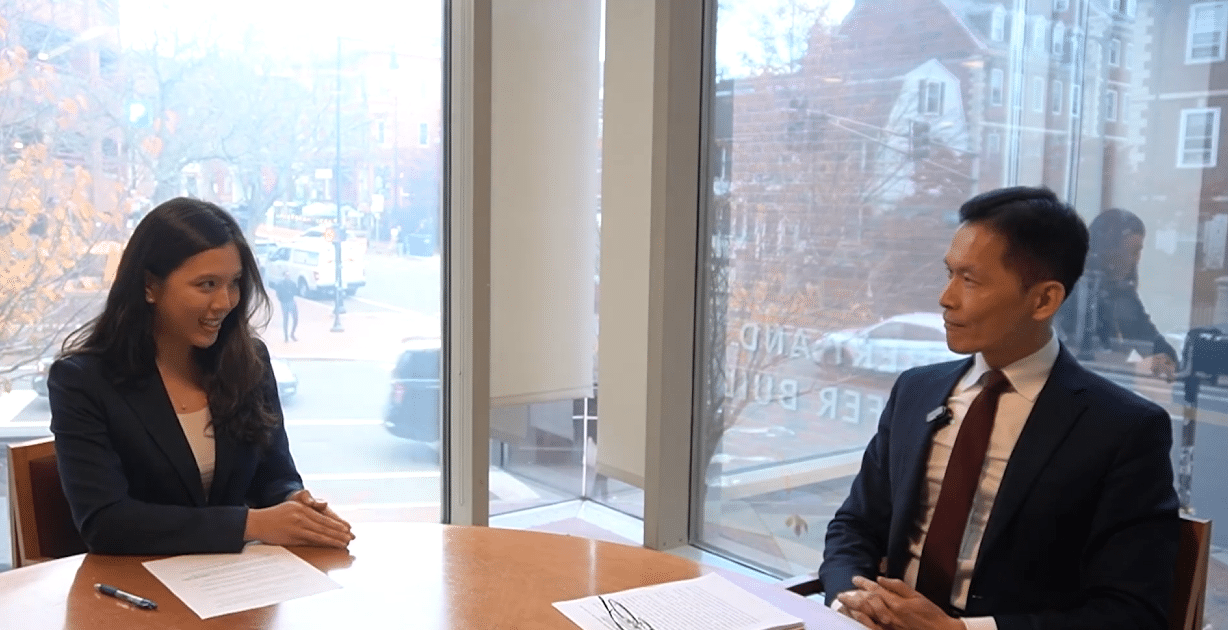
For 20 years, Charles Liao has been at the forefront of cultivating and strengthening Taiwan-U.S. relations. He’s the Director-General of the Taipei Economic and Cultural Office (TECO) in Boston, one of 13 de facto consulates across the U.S. Before Boston, Liao served as a senior envoy to Washington, D.C., and Los Angeles, and as the Deputy Secretary-General of the Taiwan Council for U.S. Affairs, under the Foreign Minister’s Office.
Mr. Liao agreed to an interview with the Harvard Kennedy School Student Policy Review (HKSSPR) to discuss the U.S.-Taiwan relationship and what Taiwan represents today, including its status as the unmatched producer of almost all the world’s most advanced semiconductors. For more of the conversation, watch the video interview here or view it embedded below. A transcript follows, which has been edited for length and clarity.
SPR: How have the priorities of your mission changed over your career?
CL: When I was first posted to the U.S. in 2004, the focus on Taiwan-U.S. relations was mainly on promoting bilateral cultural and economic exchanges. At the time, the regional security environment was relatively stable. Taiwan’s international visibility was also more limited. Over the 20 years, both the Taiwan-U.S. relationship and the international landscape have changed dramatically.
Last year, Taiwan was the U.S.’ seventh largest trading partner. The U.S. has also become the top destination of foreign investment from Taiwanese companies. So, you can see that the bilateral relationship has advanced to another level. Regarding the international landscape, we’re seeing the war in Ukraine, the expansion of authoritarianism, more concerns over the security of global supply chains, especially in semiconductors, and all of these have reshaped Taiwan’s role in the world.
Today, we are focused on strengthening cooperation around economic security, technology, defense, and international participation. We are working closely with all stakeholders to highlight Taiwan’s contribution to U.S. economic prosperity and national security.
SPR: On the issue of promoting Taiwanese investment to the U.S., from your experience talking to Taiwanese businesses here, what are the main challenges to overcome?
CL: Against the backdrop of global supply chain restructuring, we have seen more Taiwanese companies invest in the U.S. For example, TSMC announced an additional 100 billion U.S. dollar investment earlier this year, making it the largest-ever foreign investment in U.S. history. That also underscores our commitment to strengthening the global supply chain and supporting bilateral technological advancement.
But indeed, sometimes companies face some challenges here, including a skilled labor shortage. That’s one of the biggest challenges I hear from the business community. Companies face construction delays, and perhaps this is partly due to unfamiliarity with local construction norms or permitting processes. We’ve also heard about high costs of building and operating a factory in the U.S. compared to in Asia.
SPR: How can these investments to the U.S. be justified given these challenges?
CL: For TSMC, its chair C.C. Wei has said it’s investing to be closer to its customers. U.S. companies are TSMC’s biggest customers. Firms can also take advantage of the global talent in the U.S., which would be good for the company’s image. I believe Taiwanese companies will overcome these challenges because over the past few decades, they have shown incredible flexibility and adaptability.
On TSMC, from the government’s point of view, we are happy to see [this expansion] because we believe this is a win-win situation. We’ve seen both Taiwan and the U.S benefit from these partnerships which support economic growth. We understand that U.S. policy under the current administration is to domestically reindustrialize, and I believe Taiwan can help the U.S. advance their technology to achieve their goal.
SPR: How do you respond to concerns over what Taiwan is getting back for this collaboration? Are you concerned Taiwan is losing some of its advantage?
CL: On the contrary, we believe this will reinforce Taiwan’s leadership role in the semiconductor industry. Our policy is to help these companies expand their footprint worldwide, while being rooted in Taiwan. Ultimately, Taiwan is a small island, and when companies grow to a certain scale, they must expand eventually. These companies have promised they will keep their most advanced technology and R&D in Taiwan. Expanding overseas wouldn’t delay these plans to continue investing in Taiwan.
SPR: A big moment for U.S.-Taiwan relations was in 2022, when then-U.S. House Speaker Nancy Pelosi broke tradition and visited Taiwan. At the time, you were the Deputy Secretary-General of the Taiwan Council for U.S. Affairs. What was that moment like when you found out Speaker Pelosi was coming?
CL: The U.S. and Taiwan kept very close communications before the visit. At the time, I was in the headquarters in Taipei. Eventually, this was a decision made by Speaker Pelosi, and Taiwan and the U.S. are both democratic countries. So, a friend visiting another friend should be a natural thing. And actually, Speaker Pelosi is not the first sitting U.S. speaker to visit Taiwan. [Editor’s Note: In 1997, Republican House Speaker Newt Gingrich traveled to Taiwan.]
Taiwan’s international visibility is very limited. China continues to distort and misinterpret the United Nations General Assembly Resolution 2758. They misuse that to exclude Taiwan from international participation, but, if you look at the resolution, it never mentioned Taiwan or authorized the PRC to represent Taiwan. So, Taiwan has been unfairly treated for a long, long time. For any friend, like a friend from the U.S., who wants to visit, of course we welcome them.
Many people might say that because of Pelosi’s visit, China escalated tensions. I think China used [Pelosi’s visit] as a pretext or an excuse to put pressure against Taiwan and do what Beijing wants to do. You can see now that the situation is not only in the Taiwan Strait. In the South China Sea and East China Sea, China’s expansion has caused worry in all the neighboring countries.
SPR: Chinese military coercion has not stopped. Chinese forces breach Taiwan’s Air Defense Identification Zone almost daily. What’s different about your current mandate representing Taiwan in the U.S. under Taiwanese President William Lai?
CL: President Lai took office at a time when the CCP continued to step up its pressure and intimidation of Taiwan. In the face of a very hostile environment, and to maintain the status quo of Taiwan Strait, President Lai has proposed the Four Pillars of Peace Action Plan. This includes strengthening national defense and deepening our economic security. We are also deepening our cooperation with diplomatic allies. The last pillar is to establish a stable and reliable leadership role in cross-strait relations.
At the same time, we keep pursuing foreign policy in a practical way based on values, outlined by Foreign Minister Lin Chia-lung. We want to show that a resilient Taiwan is essential to the Indo-Pacific region, which ultimately benefits everyone. Our approach is a “Taiwan +1” strategy, which means, for example with the U.S., we help the U.S. achieve their goals and maintain a close partnership to achieve mutual prosperity.
On the security front, we have raised our defense budget almost 80% since 2016. Next year, our budget will reach 3.2% of GDP. We are also working very hard to enhance our whole of society resilience. That shows our commitment to defend ourselves, preserve the status quo, and work with other democratic allies.
SPR: How are your messages being received? On defense spending for instance, Washington has also been quite vocal that they wish to see an even higher level of GDP.
CL: If you look at the broader picture, not only Taiwan, but you can see democracies in Europe and in Asia, like Japan or Australia, even Canada, almost every country has raised their defense budget in the past few years. I believe the reason is that we all feel the pressure and threat from authoritarian regimes. We are responding to that kind of expansion.
China will say it’s the U.S. or Taiwan being provocative, which is why they will respond with military exercises. But that’s just not true. The truth is democracies around the world are trying to safeguard the rules-based international order and our cherished democratic values.
SPR: Taiwan has been facing a divided local political landscape. What do you say to your counterparts overseas who see this situation and are concerned about it?
CL: That’s part of our democracy. Democracy is not perfect, right? Especially since Taiwan is a young democracy. We had our first presidential election in 1996, and last year we finished our seventh presidential election. But the world can see all the achievements we have made in this short period, and we are proud of that.
The most important message that I tell my friends here is that we are very committed. We will try everything to defend the democratic way of life. It’s become a part of our DNA. I believe the consensus among the Taiwanese people is nobody wants to give up their freedoms and democracy, so I hope the CCP can realize this fact.
SPR: Because Taiwan doesn’t have official diplomatic ties with the U.S., there’s no embassy here, but there’s the Taipei Economic and Cultural Office (TECO). How do you do your work in the absence of diplomatic relations?
CL: It does create some challenges for our work, especially when it comes to some formal international events or meetings, especially related to the UN framework or UN agencies. But thanks to the Taiwan Relations Act, passed by U.S. Congress in 1979 and the Six Assurances, that laid a solid foundation for Taiwan-U.S. relations to significantly advance in many areas.
Some friends here get confused about the function of my office. One common misconception is that TECO is a private company, or that we only provide visa and passport services. Our function is much broader than that. We have trade, economic, education, and other cooperation. We serve as a bridge for Taiwanese and local communities here.
Our partnership is still very comprehensive even though we don’t have formal relations. Back when I was in Washington, D.C., some of my friends at the State Department used to joke that they were handling many more Taiwan-related issues than those of other diplomatic allies. That just shows how close we are.
SPR: Have you noticed changes in people’s impressions of Taiwan over the years?
CL: Indeed. 20 years ago in Los Angeles, people would think I’m from Thailand. But nowadays when I say Taiwan, people bring up TSMC and chips. But Taiwan is much more than TSMC and bubble tea. We have much more to offer. Taiwan can be a force for good in the world even though we are excluded from most international organizations. But we are trying our best to help, whether in humanitarian assistance or elsewhere, Taiwan can contribute to the greatness of international society more than people think.
To watch the rest of the interview, please click here.
HKS Student Policy Review Staff Editor and Media Team member Youyou Xu served as videographer for this interview.
[i] “R.O.C. (Taiwan) government has terminated diplomatic relations with Republic of Nauru with immediate effect to uphold national dignity,” Ministry of Foreign Affairs, Republic of China (Taiwan), January 15, 2024, https://en.mofa.gov.tw/News_Content.aspx?n=1330&s=116429.
[ii] “No change in Taiwan policy, State Department says,” PBS News, May 24, 2022, https://www.pbs.org/newshour/politics/watch-live-state-department-spokesperson-ned-price-holds-news-briefing-17
[iii] “川普:台灣就是台灣 不確定是否和習近平談兩岸議題[影],” Central News Agency, October 29, 2025, https://www.cna.com.tw/news/aipl/202510290111.aspx.