
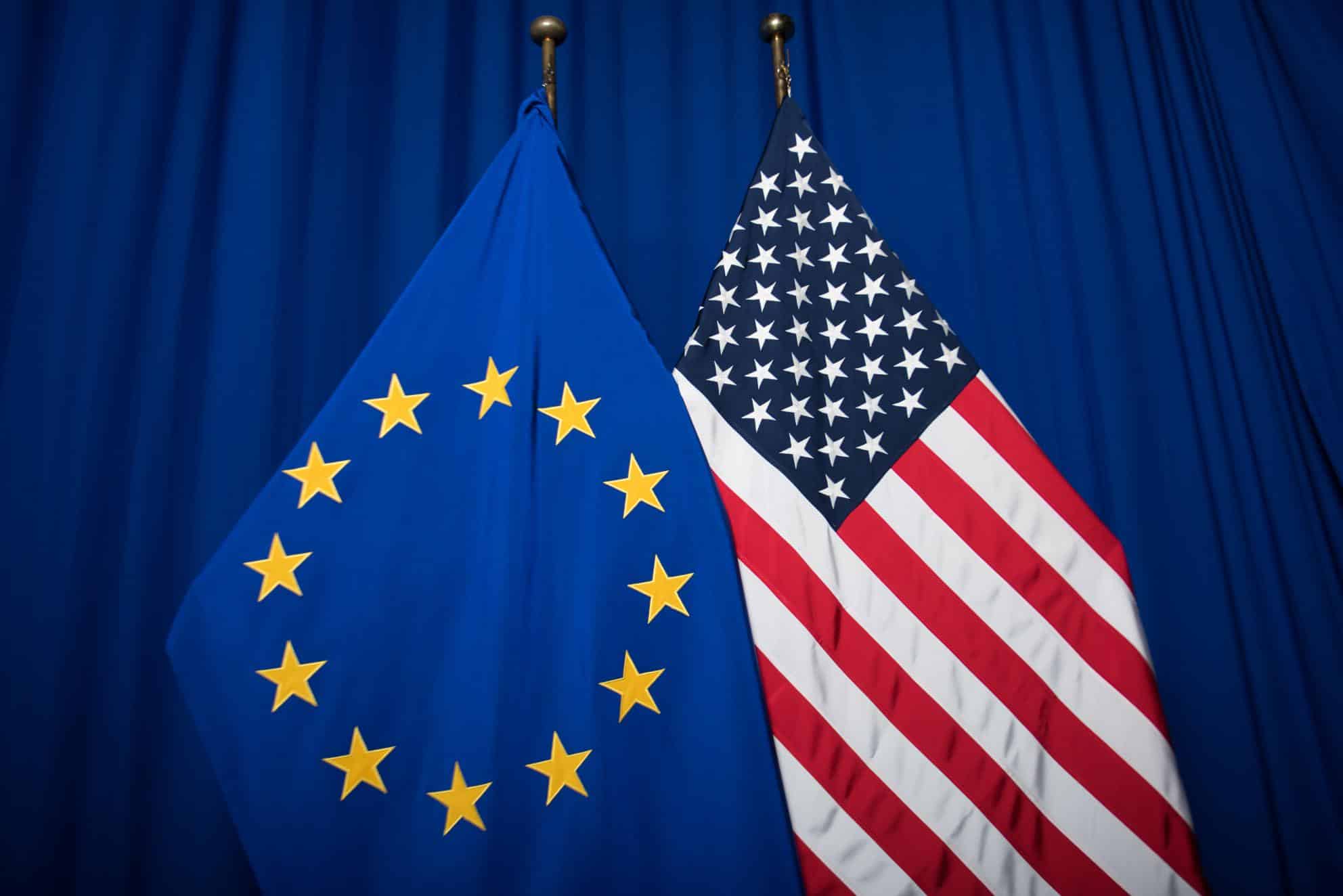
The transatlantic alliance is increasingly described today in terms of decline, rupture, and even collapse.[1] Political leaders and commentators on both sides of the Atlantic have openly questioned whether the relationship can endure in its current form. From warnings that it is “broken” to claims that it is effectively “over,” the narrative of a fading partnership has taken hold.
Yet, this narrative only tells part of the story. Beyond the political statements and rhetoric, the reality of day-to-day policymaking tells a very different story.
The real danger is not the strain itself, but a growing gap between perception and reality. If policymakers begin to act assuming that the relationship is already broken, that perception risks becoming a self-fulfilling prophecy, accelerating the decline.
There are, of course, reasons why this narrative has taken hold. Disputes over defense, trade, shifting security priorities, unprecedented threats over Greenland, and the pressures of ongoing conflicts from Ukraine to Iran have all contributed to a sense of fragmentation. Differing public rhetoric on both sides of the Atlantic has, at times, reinforced the impression that cooperation is fading.
German Chancellor Friedrich Merz has warned[2] that the alliance is facing a historic “stress test.” Canadian Prime Minister Mark Carney, speaking from Davos, highlighted the risks of a broader “transatlantic breakup.” This sentiment is echoed by leading experts like former U.S. Ambassador to NATO Ivo Daalder, who questioned whether this could signal “the end of NATO.”
Yet, despite mounting challenges, deep cooperation continues at the administrative level, largely out of public view.
As leaders of the European Club, a student organization at Harvard Kennedy School, we organized a tightly packed program in Washington, D.C. for a delegation of students. We sat face-to-face with the people shaping transatlantic relations every single day, including senior EU diplomats, the US Treasury, State Department, the office of the US Trade Representative, Congress, and others.
We expected reticence, pushback, or maybe even downright hostility. However, what we found is just how misleading this assumption can be, one that can prove costly.
Washington officials welcomed us with open arms and dialogue that continued well beyond the scheduled hours. This inspired hope and confidence in us, leaving us certain of one thing: the Transatlantic Alliance is not dead.
However, it risks being buried by a growing disconnect between perception and facts.
Intertwined
To be clear, no one denied that the relationship faces serious challenges. Yet the message was clear: cooperation continues, even if it’s less visible and often overshadowed by political rhetoric.
There are a few reasons for this
Economically, the U.S. and EU remain each other’s largest investors by far. The U.S. owns the largest share in EU foreign direct investment stock, with €2.24 trillion[3] at the end of 2024. At the same time, the U.S. is also the single largest destination for EU investment, with €2.67 trillion[4] invested in the U.S. Importantly, the broader transatlantic economy supports more than 16 million jobs on both sides of the Atlantic.[5] These economic ties span from supply chains to labor markets, and are deep and not easily broken.
Energy is another area of deep cooperation between the EU and U.S., mentioned most frequently in our meetings. After Russia’s full-scale invasion of Ukraine, Europe’s import of US liquefied natural gas (LNG) more than doubled[6] — from 34% of all exports in 2021 to 69% the following year. At a time of true crisis, it was America that Europe turned to. The Iran War has repeated the pattern: with the Strait of Hormuz effectively closed, the U.S. is set to provide two-thirds of Europe’s LNG in 2026.[7] This doesn’t mean that Europe has abandoned its long-term push toward renewable energy and less dependence on imported fossil fuels, but it shows just how deep the partnership between the two global superpowers really is.
American corporate giants are also doubling down on Europe. Microsoft is announcing[8] multi-billion-euro investments in European AI and cloud infrastructure, while Amazon is increasing its investment in Spanish data centers to €33.7 billion[9] ($39.8 billion). European firms are also deeply embedded in US markets. This kind of economic partnership and reliance doesn’t disappear overnight.
The People and the Power of Perception
As one delegate aptly put it, it’s not just politics that’s on the line – the transatlantic relationship is, at its core, about “people-to-people” connections. Exchange programs like Fulbright continue to bring thousands of students, researchers, and professionals across the Atlantic every year. The decades of shared experience and collaboration give this relationship resilience that extends beyond the ebbs and flows of political cycles.
Of course, there is a grain of truth in all the headlines. It would be naive to ignore this reality. However, based on what we saw and heard, the headlines simply don’t capture the whole story.
Disputes over defense, trade, and shifting security priorities have placed the transatlantic relationship under severe strain. There is no denying that. Yet the greatest danger is leaning into the prevailing perception, particularly in Europe, that the relationship as a whole is close to breaking and the US isn’t willing to save it. If this tune is allowed to proliferate, it can shape behavior in a way that discourages constructive dialogue and destroys the trust carefully built over decades. Policymakers will start to disengage, transatlantic initiatives will lose momentum, investment will slow down, and the human connections that bind the two sides of the Atlantic will begin to fade, with no structures in place to rebuild trust. In short, it can become a self-fulfilling prophecy.
Precisely because of the changing world order and geopolitical instability, this matters now more than ever before. Coordination on energy, security, trade, technology, and AI governance is essential to withstand growing competition from other powers- most notably China.[10] But this cooperation becomes harder to sustain as both sides question whether the relationship is still worth investing in.
Worth the Effort
What we saw in Washington showed us that the Transatlantic Alliance is still intact, but it is not what it once was. It’s less vibrant, less politically unified, and more contested. Crucially, it is far from dead.
It is deeply embedded in the institutions, economic ties, and human relationships that remain strong despite the pressure. The real danger is if either sides of the Atlantic start acting as if it is already doomed.
If our experience in the US, and particularly in DC, taught us anything, it is that this relationship is worth the effort.
[1] Steven Erlanger, “Every Trump Threat to Abandon NATO Hollows It Out,” New York Times, April 2, 2026. https://www.nytimes.com/2026/04/02/world/europe/trump-nato-iran.html
[2]. Deutschland.de, “Talks in Paris: Merz Warns of Stress Test,” accessed September 2, 2026, https://www.deutschland.de/en/talks-in-paris-merz-warns-of-stress-test.
[3]. Eurostat, “Foreign Direct Investment—Stocks,” Statistics Explained, March 2, 2026, https://ec.europa.eu/eurostat/statistics-explained/SEPDF/cache/65110.pdf.
[4]. Eurostat, “Foreign Direct Investment—Stocks,” Statistics Explained, March 2, 2026, https://ec.europa.eu/eurostat/statistics-explained/SEPDF/cache/65110.pdf.
[5]. Daniel S. Hamilton and Joseph P. Quinlan, The Transatlantic Economy 2025: Annual Survey of Jobs, Trade and Investment between the United States and Europe, 22nd ed. (Washington, DC: Foreign Policy Institute, Johns Hopkins University SAIS/Transatlantic Leadership Network, 2025), https://transatlantic.amchameu.eu/wp-content/uploads/2025/03/Transatlantic_Economy_2025_web.pdf.
[6]. U.S. Energy Information Administration, “Ten Years after First Sabine Pass Cargo, U.S. LNG Exports Are Still on the Rise,” February 24, 2026, https://www.eia.gov/todayinenergy/detail.php?id=67224.
[7] Institute for Energy Economics and Financial Analysis, “Europe to Source Two-Thirds of Its LNG Imports from US in 2026 as Dependence Deepens,” May 13, 2026, https://ieefa.org/articles/europe-source-two-thirds-its-lng-imports-us-2026-dependence-deepens; Chris Aylett and Zissis Marmarelis, “Even Hormuz Reopening Will Not Resolve Europe’s Key Energy Vulnerability,” Chatham House, June 18, 2026, https://www.chathamhouse.org/2026/06/even-hormuz-reopening-will-not-resolve-europes-key-energy-vulnerability.
[8]. Samer Abu-Ltaif and Jeff Bullwinkel, “One Year On: Progress on Our European Digital Commitments,” Microsoft On the Issues, April 29, 2026, https://blogs.microsoft.com/on-the-issues/2026/04/29/one-year-on-progress-on-our-european-digital-commitments/.
[9]. Amazon Staff, “Amazon Increases Investment in Spain to €33.7 Billion to Expand Data Center Infrastructure and Drive AI Innovation across Europe,” About Amazon, March 2, 2026, https://www.aboutamazon.com/news/company-news/amazon-spain-investment.
[10] European Commission. Strategic Foresight Report 2023: Sustainability and People’s Wellbeing at the Heart of Europe’s Open Strategic Autonomy. Brussels, 2023, 8. https://commission.europa.eu/system/files/2023-07/SFR-23-beautified-version_en_0.pdf